Showing posts with label aleatoric exercise. Show all posts

Sunday, December 29, 2013

Aleatoric exercise: Let's Deal!

In a previous post on exploring chance, we used dice to come up with some aleatoric ideas. In this post, let's talk about creating decks of cards.

For this activity, all you will need is blank note cards. I will use these to come up with chord progressions, but you can use them for melody, rhythm, or even form. A deck of cards can have an advantage over the dice because once you deal out your musical elements they are right in front off you to play with.                                                                                 
I wanted to work on voice leading and triads. I created a deck of 48 cards consisting of 12 major, minor, diminished and augmented triads. How I use it in my practice is to deal out a random set (anywhere from 2 to a dozen cards) and create a chance chord progression. I then explore ways I can connect these harmonies. This may also result in a composition, but could just be a practice exercise.

Let's deal!

My deal is as follows:


Once I dealt out my six triads, I need to explore them. Here I limit myself to standard closed voicings (I used the enharmonic equivalent of Ebdim and Gbm). I then voice each of the triads to create smooth voice leading. The basic rule is that no voice (especially the top voice) should move more than a minor third. Half steps and whole steps are preferred. Once you work through one set, the other sets are simply inversions of the first.

Each one of these creates a guide tone melody on top. Pay attention to those moments that stand out as a memorable melody.


If the aleatoric exercise ended there, that would be a useful exploration. This is a great way to learn about harmony and voice leading. If that is your goal, deal out another hand and explore. However, since I liked this progression, let's see if I can flesh out a tune.

First, after playing around with these triads I will choose from each set a triad that has a melody note that give me a pleasing guide tone line. This will form the basis of my main melody.


Now, I'm going to play. I am going to take this progression and work out ways to embellish the simple guide tone melody. Don't worry about key while you do this. That will be established more when we add bass notes later on. Right now, just create a melody that fits this progression. Stick to the basic guide tone line, BUT if you hear something that breaks it up, by all means explore. 

You can also change the harmonic rhythm at any time. If you want to stay with one chord longer or shorter please do so. You should spend a decent amount of time on this part of the process. You will want to make sure you are playing and singing WHILE you are composing. Don't just write it out on staff paper and hope it works. 

I recommend recording while you play around with the melody. That way if you stumble across something you like you can go back, listen to it and then write in on the staff. If you sing or play a melodic instrument, make sure you work on this at the piano (or record a chordal accompaniment). 

Here is what I came up with (pardon the rhythmic freedom in the following performances.):


Note I expand each chord to two bars each. I'm hearing this with a light bossa groove but that may change as I add more to the composition. Rhythmically, I will probably add the anticipations to beat 1 (on the + of 4) that you hear in the recording. I played with different rhythms for bar 6 as you can hear in the recording.


This melody cycles back nicely on the repeat. I think it makes for an interesting 12-bar A section of a tune that is not a blues. I like it.


Now it's time to add root motion. Now if you are writing in a style that harmonizes melodies with mostly triads you may not need to change much. However, I would like to thicken up these harmonies and add an interesting root motion. So essentially I will add a bass note below each triad. This may change the function of some of these chords and will definitely change the color.


Here I add the bass notes:


And here is the reharmonization (note that I took the liberty of making the f#m/B a B7sus4 (or B9sus4) even though an E natural is not in the original exercise). The final product of this 12 bar A Section:


In a future post I will show you how I developed the rest of the composition. In the meantime, write out a deck of cards and deal yourself some music!


Thursday, November 28, 2013

Oblique Strategies

Musician Brian Eno and artist Peter Schmidt produced their first set of Oblique Strategies in 1975. It was subtitled One Hundred Worthwhile Dilemmas and featured a deck of cards with a suggestion on each card. The cards can be used to inspire lateral thinking in any situation that requires problem solving. After a question is posed or problem encountered you simply draw a card and go. 

Each card is open ended in its direction. Some are deliberately obscure (Water) while some are more direct (Don't be afraid of cliches). When drawing a card the authors encourage us to trust it "even if it's appropriateness is quite unclear".

Some examples of the strategies:
  • Use an old idea.
  • State the problem in words as clearly as possible.
  • Only one element of each kind.
  • What would your closest friend do?
  • What to increase? What to reduce?
  • Are there sections? Consider transitions.
  • Try faking it!
  • Honour thy error as a hidden intention.
  • Ask your body.
  • Work at a different speed.
I received the latest edition of these cards from a good friend for my birthday. They have been very enjoyable to work with and apply to situations. I often pull one out and use it as I explore a concept in improvisation or composition. Sometimes I will draw the card and use the idea when playing through a familiar tune or modal vamp. 

Let me try some. To be consistent I'll play over the same vamp. It is a simple I-VI-ii-V progression with bass and drums at a medium swing groove. I did one take and played with each idea for a few minutes. Really though, I could explore these for a long time and in a variety of ways.

 My first draw.


For this one, I decided to improvise lines that begin quite busy. Each bar is filled up. Then I begin to subtract notes upon each pass of the progression. It becomes more sparse as time goes on until I have one note per change. Usually improvised solos start sparse and become busier. This is the opposite and felt interesting.


My second:


Here I decided to comp. The first passes are very much "inside" the harmony. Then I step "outside" by using ambiguous quartal voicings that move all over the place. I really enjoy basking in the dissonance. However, the trick is to know when to resolve them and to do it with grace. 


And the third:


There a few licks that I have tried to avoid lately. In the past I found myself overusing these "sweep" arpeggios. It is a technique on the guitar that helps us get a little closer to what sax players can do. However, they are flashy and quite tempting to pull out. This card spoke to me and said to play these flashy lines with gusto. After playing, I realized that I need to spend more time on these. Not only to clean them up but to find more clever ways of using them. 


Monday, November 11, 2013

Aleatoric Exercise: Let's Roll!

Karlheinz Stockhausen 
presenting a graphical score
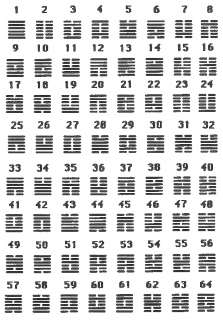
Aleatoric (or "chance") music is any music where some of the performance or composition elements are left up to chance. 20th century classical composers such as Pierre Boulez,  Karlheinz Stockhausen, and John Cage used a variety of techniques to incorporate randomness in their compositions. Boulez would compose a number of musical options that the musician could choose during a performance. This would create what Boulez called a "mobile form". Stockhausen would often use non-standard graphic notation which provides the performer with a general guide to interpret the music in her own manner. Thus the piece would change from performance to performance depending on the interpretation of the graphic. Cage composed his Music for Changes by consulting the I Ching (an ancient Chinese book that is used for divination) to determine duration and pitch as used in the composition.


The I Ching: 64 hexagrams used by 
composer John Cage 
and jazz guitarist Pat Martino
As jazz musicians explored "free" jazz and the avant-garde in the 1960s they would also add chance elements to their playing. In improvisation, musicians like Ornette Coleman, John Coltrane and Sun Ra would make one or more elements of the performance "free". They may abandon a defined meter, tonality, harmonic progressions, or even the beat. These elements would be free to the improvisor and their ensemble to collectively determine during the performance. Jazz guitarist Pat Martino has also used the above mentioned I Ching to explore string combinations available on the guitar.

An important aspect of all of the above examples is to recognize that the artist only uses chance for a part of the project. If the entire creation was left up to chance there would be no human input. It would not be music. However, using varying degrees of chance to lock in certain elements can get the musician to explore those other elements more freely (see the previous post on Limitation Exercises).


Let's explore. Any element of music can be left up to chance. Melody, harmony, chord progression, rhythm, and form are all fair game. It is best to start with just one and explore that thoroughly. You can also explore this as composition or as a spontaneous improvisation.


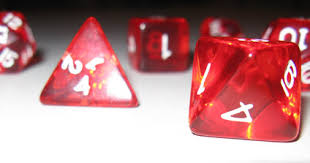
A set of polyhedral dice 
(d4, d6, d8, d10, d12, d20)
The first thing we need is a random generator. I don't think you need anything as esoteric as the I Ching. A simple set of polyhedral dice that you would would find at a game or hobby shop (or Amazon) would work well. For our purposes the most useful would be the following dice: d4, d6 (which you probably have already), d8, and d12. You can actually create any sided dice by always rerolling certain numbers (a d6 can be a d5 by rerolling any 6s).

I recommend real dice because nothing beats the feel of chance in your hands. But if you must, here is a useful "virtual dice" website.


I hesitate to define this process too much. Part of the fun is the exploration and the freedom. If one of these ideas sounds intriguing go for it. Don't be afraid to change it as you go or to even abandon the chance technique. If you hear something in your ear so strongly, then by all means stop the chance and start creating.


To get you going, I recommend you follow these steps:
  1. Choose a main element of composition or improvisation you would like to explore (harmony, melody, rhythm, form). 
  2. Define one aspect of that element (intervals, measures, chord tones, sections, chord quality, rhythm, meter, etc.)
  3. Match that aspect with the dice (d2/coin, d4, d6, d8, d10, d12, d20) that you feel is most appropriate. This is where you can be creative. Eventually you can combine these elements as well.
Here are some ideas to get you going. Choose one of them that seems interesting. Or let them inspire you to create your own. However, DO NOT do all of them at once. You will be overwhelmed. Choose just one for now! Later on you may combine them. Let's roll!


Melody:
  • Roll a dice to determine the interval from one pitch of a melody to the next. You can make the melody ascend/descend as needed to determine an appropriate contour. Use larger dice for a more disjunct melody. You can make the intervals major or minor depending on the key. 
    • Example: A roll of : 4, 2, 5 would yield a four-note motive. You can choose if you wish to ascend or descend with each interval.  Keeping it diatonic in the key of C Major and starting on Do could yield: C (up a 4th) F (down a 2nd) E (up a 5th) B.
    • Or you can ignore the key and use a coin or dice to determine if the interval is major/minor/augmented/diminished.
  • Roll a 12 sided dice to create a pseudo-"tone row". Designate 1 as a pitch with the other 11 forming the chromatic scale. You could ignore repeated notes or embrace them.
  • Choose a pitch collection that fits a particular dice. Some examples:
    • d4 - tones of a 7th chord; a tetrachord (like Do Re Me Fa or Fa So La Ti)
    • d6 - a hexatonic structure (like Do Re Mi So La Ti); a whole tone scale; a pentatonic scale (reroll 6s); a blues scale (1 b3, 4, b5, 5, b7)
    • d8 - any 7 note scale (major, harmonic/melodic minor, or their modes (reroll 8s), octatonic (diminished scale)
    • d12 - the chromatic scale
    • Then with that chosen pitch collection/dice, roll to compose a melody. Assign a value of the dice to each note. Roll until you feel you have a complete melody/phrase. Or you can even predetermine randomly how many rolls you will make. The choice of octave is up to you.
    • You can also any of the above to determine root motion (see harmony below).
  • You will need to create the rhythm and harmonic accompaniment of the "chance" melodies. This is how you will make this chance process musical and human. So once you have your notes, add rhythm and harmony to make it your own.
Harmony:
  • Roll a d4 to determine the quality of the next chord (major, minor, diminished, augmented).
  • Roll a d6, d8, or d12 to determine the root of the next chord.
  • Roll a d8 to determine the function (roman numeral of the next chord).
  • Roll a d12 to determine a single pitch that MUST be present in all of the chords you place in a piece (or a section of a piece). That tone may be in the basic triad or in one of the extensions (7th, 9th, 11th, 13th or altered sounds).
Meter/rhythm:
  • Roll any dice to choose a meter.
  • Roll a d4 to build an irregular compound meter. (e.g. You roll 3, 2, 2, 3. That could be a 10/8 time signature with the following pulse in bold (1 2 3 4 5 6 7 8 9 10) or in konokol (ta-ki-ta, ta-ka, ta-ka, ta-ki-ta)
  • Roll a d6 to determine the rhythmic value of the next note or group of notes. Assign a value to each number (e.g. 1 - whole, 2 - dotted half, 3 - half, 4 - quarter, 5 - eighth, 6 - sixteenth).
Form:
  • Roll a d20 to determine a length of a section (# of bars)
  • Roll a d4, d6, or d8 to determine the number of sections.

Good luck. In future posts I will pick one of these and demonstrate the process. Keep in mind that these techniques do not have to be used to compose a whole piece. You may use it just to get going, or to get you out of a dead end. You also may not wish to create a whole piece with the technique. You may just wish to use this as an exploration tool. I explore that in future posts as well.


Melodic Contour Exercise

An effective and quite creative method for composing/improvising strong melodies would be to connect it with the visual artist's techniq...